
Does Your Business Actually Need AI? Ask Bunnings.
Apr 27, 2026 · ~ 7 min read
I asked the Bunnings AI to find a pressure washer. It found one, then didn't. A question about AI in everyday products, and who it's really for.
// contents(5)
I want to be upfront: this is not a hot take from someone deep in enterprise AI deployments. I am a developer who works with AI tools regularly enough to have opinions, but not so regularly that I have lost the ability to be a normal person on a website looking for a pressure washer.
Which is exactly what I was doing on the Bunnings website recently.
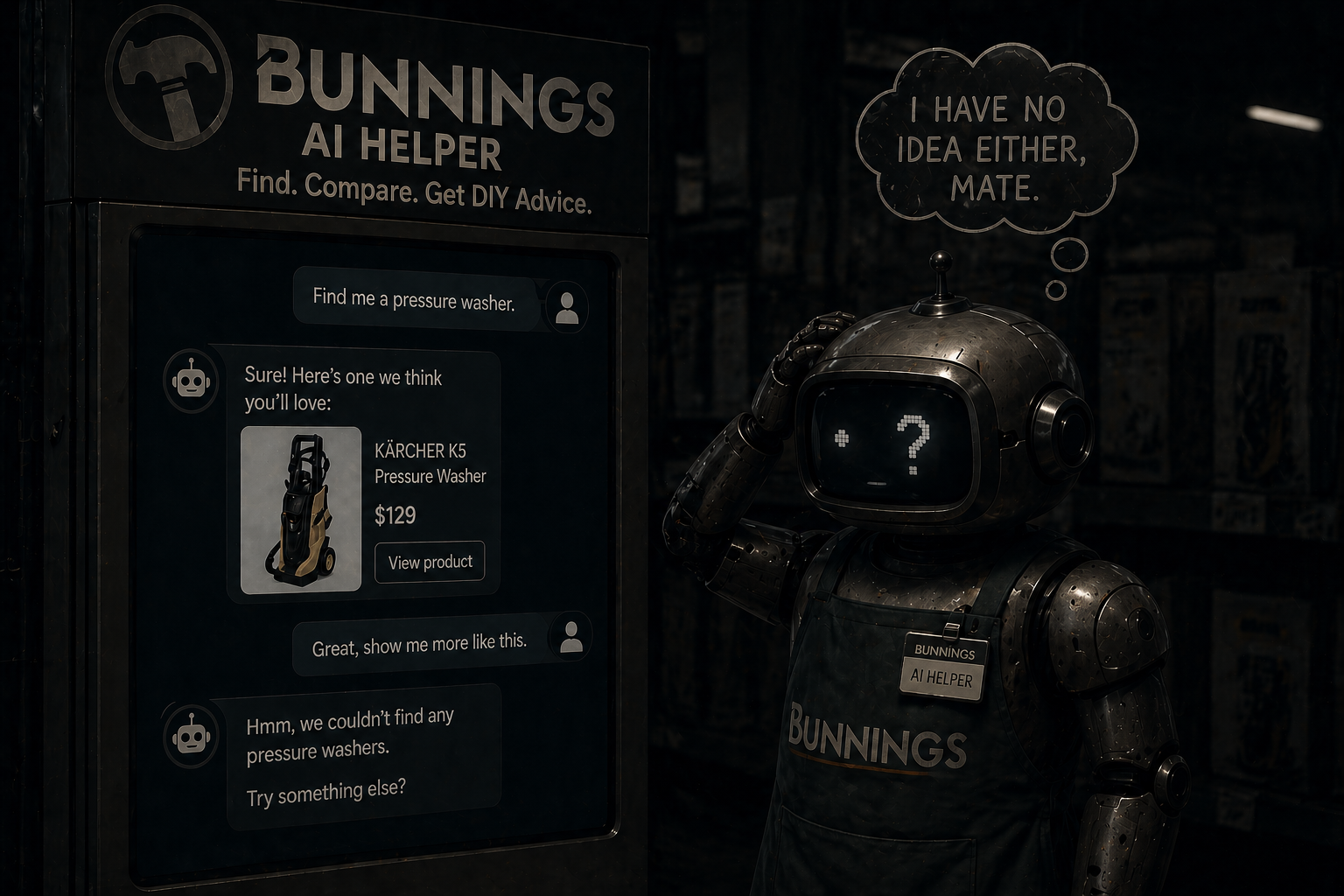
They have an AI assistant now. I gave it a go. I asked if it could help me build a house, mostly out of curiosity. It said no, which is reasonable. Then I asked if it could find me a pressure washer. It said yes, found one for $129, I clicked through, got a "whoops" error page, and was redirected to a page of pressure washers starting at $199.
I closed the laptop and thought about it more than I probably should have.
The Thing That Actually Bothered Me
My first instinct was that it felt a bit off, like I had been nudged somewhere I did not ask to go. But the more I sat with it, the more I think it was not intentional at all. The $129 one was probably discontinued. The AI just did not know that, because whatever it was pulling from was not up to date with actual stock.
And that is the bit that stuck with me. Not that it failed, but how it failed.
If I had asked a staff member in the store and they had walked me confidently to a shelf, pointed at a gap, and then gestured at the more expensive ones above it, I would have walked away. Not furious, just with that low-grade feeling of having been slightly had. The thing is, a decent staff member probably would not do that. They would have some awareness of what is actually on the shelf before committing. Or they would check. Or they would say they were not sure.
The AI just went for it: full confidence, straight into a dead end. Which, to be fair, is a personality trait I recognise in a lot of people too, but we generally do not put them in charge of customer service.
That is not really an AI problem. It is a data problem. A stale catalogue, stock not syncing often enough, or something in between. The AI is just the thing that made it visible in a way that felt personal, because it was talking to me like it knew what it was doing.
The Part Where I Probably Overstep a Bit
I want to be careful here because I am not a UX consultant and I have never worked in retail tech, so take this for what it is: the idle thoughts of someone who found the Bunnings website a bit shit and hard to navigate before the AI ever entered the picture.
But I did keep thinking: what would have actually been useful?
Honestly, just knowing where things are in the store. A hardware warehouse with tens of thousands of products across a floor the size of a small regional airport is a genuinely hard navigation problem, and it is the kind of problem that existing technology handles well. The thing that finds your lost earbuds by pointing an arrow at them could theoretically point you past the paint section toward the cleaning aisle. That feels like it solves something real and specific to being in a Bunnings.
A better search would also go a long way. Or a decent product wiki. Something that could explain the difference between a pressure washer, a power washer, and apparently something called a gurney, which I have seen listed as a product on the site ( at least I think I have... ) and assumed was a medical trolley. It might still be. I did not investigate further.
Maybe the AI gets there eventually. Maybe it is already better than my one experience with it. I genuinely do not know. I just noticed that the foundations felt a bit shaky underneath it, and that made the whole thing feel less useful than it probably could be.
The Video Production Thing
This is the part I feel most confident saying because I actually lived it.
I spent years doing video production work. And there was a stretch where every company knew they needed video. Not what the video should say, or who it was for, or what it was supposed to do. Just: video. It was the moment. Agencies were selling it, competitors had it, and so the brief would arrive with a budget and not much else behind it.
The videos got made. Some were good. Most were fine. Very few connected to anything measurable, because the thinking that should have come before the video had been skipped in the rush to do the video.
I keep getting the same feeling watching companies reach for AI in their products right now. The brief is "we need AI." Whether the infrastructure supports it, whether there is a clear problem being solved, whether the user actually benefits, those questions seem to come later, if at all.
It is everywhere you look. Notion's homepage now describes itself as "the AI workspace that works for you." Notion
Canva calls its offering "AI that creates with you, and connects to your world." Canva
These are good tools, genuinely. I use both. But there is a pattern in the language: every product, regardless of what it actually does, is now primarily an AI product. Your spreadsheet app is an AI. Your design tool is an AI. Your project management software is an AI. Your hardware retailer's website is, apparently, also an AI.
None of that is inherently wrong. But when the positioning gets ahead of the infrastructure, when the chatbot is live but the product catalogue is stale, the gap between the promise and the experience becomes the thing the user remembers. And users, it turns out, remember.
The Part Where I Admit I Am Also Doing This
Here is the thing. I have been sitting on an idea for jamjam.dev, the site you are reading this on, to be an AI-powered service. Digital assistants, intelligent workflows, that kind of thing. It sounds good. I like the idea of it. I have thought about it a fair amount.
I also do not have the foundation for it yet. The site is still being built. The pipelines are not in place. The data, the infrastructure, the boring essential groundwork that would make any of that actually useful rather than just a confident chatbot pointing at an empty shelf, I have not done that bit.
So when I say Bunnings probably should have fixed a few things before deploying the AI, I am very much aware that I am typing this from a glass house. I just have not thrown the stone yet because I do not have the stone ready. That is not virtue. It is just timing.
Maybe that is the more honest version of the lesson. It is not that AI is bad, or that companies are cynical, or that any of us are wrong for wanting to build with it. It is that the exciting part, the bit that gets announced, the bit that ends up in the app, is the last five percent. The other ninety-five is just work: unglamorous, necessary, completely invisible to the person who eventually clicks through and gets a "whoops."
Anyway
I do not think AI has no place in retail. I think there are probably interesting things you could do with it once the groundwork is there. I just think the groundwork is the hard part, and it is tempting to skip it because the AI is the exciting bit and fixing a stale product catalogue is deeply, profoundly not.
The question I am left with is not really "does Bunnings need AI." It is more: what problem were they actually trying to solve, and does this solve it? I could not tell from my end. Maybe someone on the inside has a clearer answer. I hope so.
In the meantime I will probably just go into the store and ask a staff member. They are usually pretty good, actually. And they tend to know what a gurney is.
I still do not have a pressure washer btw.
Jamie McNeil
Creative developer based in Melbourne.
I build websites, web apps, and AI-powered tools. Comfortable across the stack — from design systems to deployment. Currently looking for my next role.